Sunuva Swim and Beachwear For Kids

Since it’s summer all year round in these parts, I have to keep my kids protected from the sun. Instead of just a swimsuit, my kids wear rash guards, or “swim shirts” as they call them, too.

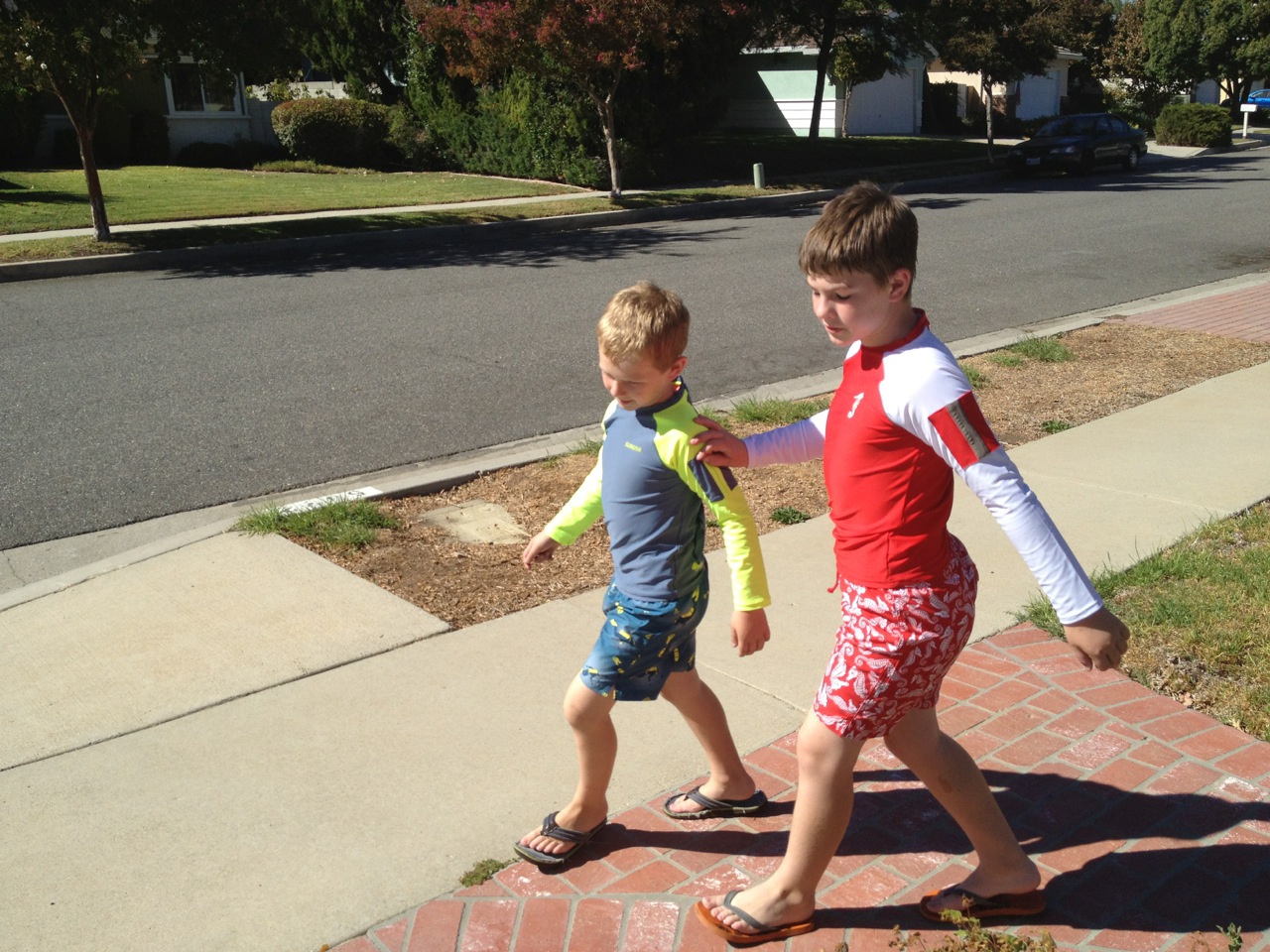
We recently tried out a new-to-us line by Sunuva, a British company started by two mothers who want to protect their kids from the sun’s harmful rays while also allowing them to get the good stuff: sunshine, vitamin D, happiness, etc. Here are my boys modeling their super cute rash guards and swim trunks on their way to a pool party:

IMG_9543

IMG_9544

Sunuva’s rash vests are made from Italian fabric providing 50+ UPF for your kids. UPF is a measure of the UV Protection Factor given to the skin by a fabric. A UPF rating of 50+ gives excellent UV protection, blocking out 97.5% – 98% of the sun’s rays. The high quality fabric used also meets the stringent and highly respected Australian and New Zealand sun protection guidelines (AS/NZS 4399:1966).

The kids gave these pieces their seals of approval by not ripping them off of their bodies as soon as they were out of my sight. The shirts and trunks are made of sturdy fabric that doesn’t itch, and the styles are fun, too! You can buy Sunuva clothing at the Four Seasons Hotel on the Maldives…but it might be more convenient to simply order them online!

We received the pictured clothing as samples from Sunuva to facilitate this review.

6 Awesome “No Soliciting” Signs For Your Front Door

warning

Next time I move (and I never want to move again, but in this world that is real vs. the imaginary one in my brain I suppose that someday we will move again) I vow to not live within easy walking distance of a main road, even in lovely little Agoura Hills. We live close enough to TO that we get the craziest door-to-door salespeople hawking solar panels, magazine subscriptions, security systems, vacuum cleaners, and even shit. Yes, that’s what I said. Manure for the grass, which is shit.

I don’t mind when our neighbors’ kids come by to sell Girl Scout Cookies, which is much like the rest of the world. And I feel bad for the people who are trying to make a living this way, but not bad enough to say “no” or to motion through the window that I am sick with a contagious disease or to not answer the door at all.

But yesterday a saleswoman put me over the edge to the point when I had to write this. A young lady tried the whole “how much do you spend on electricity every month?” pitch on me and I stopped her mid-sentence saying “We don’t want solar, please don’t try to sell it to me,” and for the rest of our encounter she gave me this disdainful, sarcastic face and kept pushing and pushing her point and wouldn’t go away so that I finally just closed the door on her.

I am a nice person. Until I’m not. I realized it might help to put a “no soliciting” sign on the front door, so I did a little search and most of them were just lame. Here are six that I loved:

No Soliciting Sign babycenterFrom a Babycenter forum

no-soliciting crazyFrom Gun Free Zone

no-soliciting-neighborsFrom Brower Creek

stompyouv1-500x500From Outlaw Biker Customs

imgur no solicitingFrom some guy on Imgur who says “So my wife got tired of people ignoring our No Soliciting sign”

soliciting lotteryFrom Lil Blue Boo

Before, During, and After: The Center For Eating Recovery

IMG_6833

Pizza = Love

Before I eat a meal, I’m supposed to pay attention to how I feel, physically speaking, and rate how hungry I am on a scale of one to ten. The higher the number, the hungrier you are. The lower, the fuller.

It’s week four of my 8-week coaching program with Alison Ross, LMFT, director of the Center For Eating Recovery on Agoura Road. Most of the CER’s clients come in seeking treatment for eating disorders like anorexia, bulimia, or problems with emotional overeating. They offer individual therapy and coaching as well as an 8-week group course where participants cozy up on a large sectional couch in Ross’s office, or join in via Skype.

I don’t have an eating disorder, but I wanted to learn more about the CER. I read their pamphlet: “Do you…cycle back and forth between watching what you eat and overeating? Does your weight fluctuate?”

And I thought of the seven Oreos I ate that morning, just because they were there. And the five pounds I gain and lose every year. And the spirited bursts of daily exercise I do during the Mamavation 2-Week Challenge every now and then, which spice up my otherwise slow-paced constitutional practice and occasional vigorous hikes.

Ross proposed an individual 8-week course of coaching. Health coaching, I like to call it. After all, “We pretty much all have something we could do, but that is hard to do, to improve our health,” she said.

For me I thought it was taking the time to make healthy meals and snacks, and committing to regular exercise. And it is, but as I have learned from meeting with Ross for a few weeks, there is so much more involved. I’m 42 years old. I have had 42 years to develop surprisingly subconscious habits and attitudes about food, and shining a light on them during my sessions has been very…illuminating.

I had planned to write about this program right as it started – a “before” post, to tell you about the center. And then again in the middle, while in the thick of it, and then “after,” to process and share what I have learned. I will still do the middle and end, but this beginning post took a while because what Ross and I talked about in our first three visits was so deep and emotional for me that until now I haven’t been able to put it into words. I’ll spare you the childhood angst and how that means pizza equals love, so you’ll have to trust me. Pizza does equal love, unless it makes it you sick the next morning.

The task that Ross and her colleagues embrace is to help their clients and patients, through coaching and therapy, to learn to separate their emotions from their physical selves so that they don’t withhold or overindulge in food (and the wrong kinds of food) to starve or feed their hearts. In other words, “change your mind to change your body.”

So far I have stated my intentions (eating more healthfully and doing yoga once a week) and identified possible sources of sabotage (not planning ahead, being lazy). Then I investigated why I allow those sabotaging moves into my life. There was some role play that featured me talking to myself. There’s no YouTube video of that, but it was very revealing. Last week Ross asked me how I know when it’s time to eat, and what followed was a discussion about paying attention to what my body tells me.

Right now it’s telling me “Thank you for the graham crackers.” A little while ago I felt hungry. On the scale, I was feeling about a 5, which is hungry but comfortable. As I was eating the crackers I thought “Yum, these are good, but I know I should have a piece of fruit instead.” After eating just enough and not too many, I felt about a 4: “Feeling full and not in need of food.”

That whole exercise was important because if I had waited longer I might have eaten a less healthy snack, or gotten very hungry by dinnertime and not given myself the time to prepare a nourishing meal. Paying attention to my hunger level and why I eat the things I eat is all part of the overall effort to bring my mind and body into harmony.

Tomorrow I head back to CER for my 4th session. By now I head up the stairs to their offices with anticipation about what I’ll learn next, and I’ll admit a little bit of fear. But even though it’s sometimes uncomfortable to discover things I think I should have known about myself all along, the work is worth it.

I’m participating in a comped 8-week coaching program at CER to facilitate this series of posts. Everything I share here is something I learned firsthand about the Center or about myself. Click here to read Part 2 of this three part series. And here is Part 3.